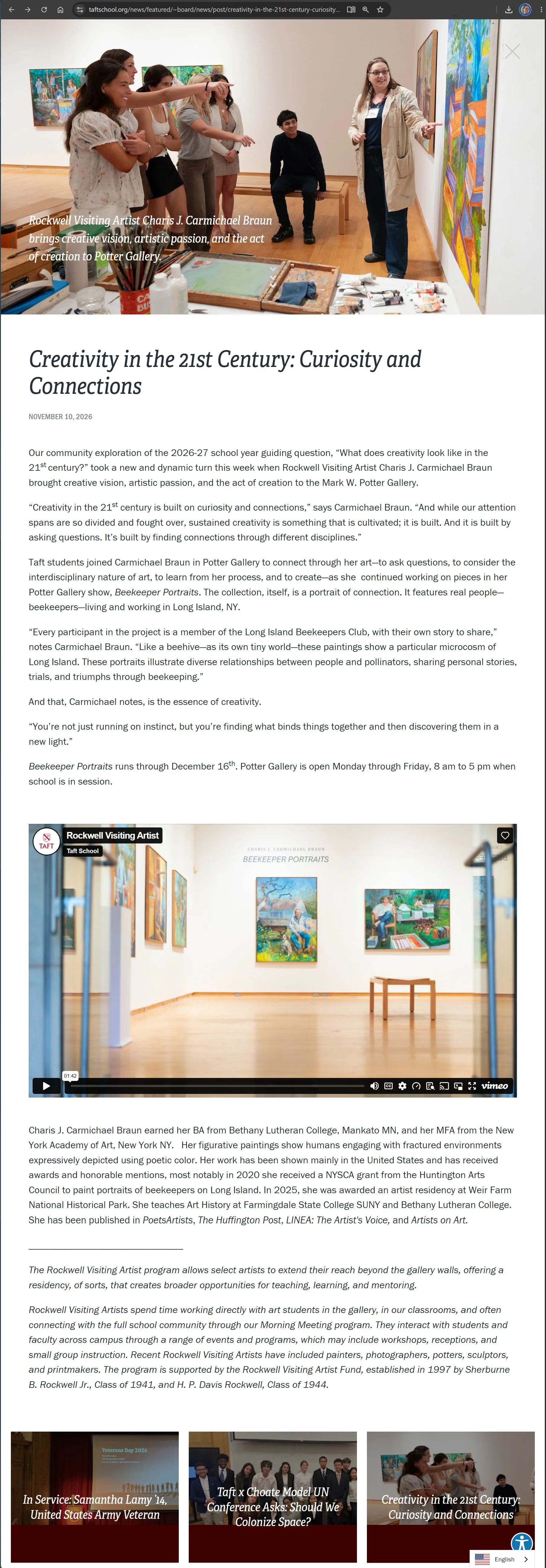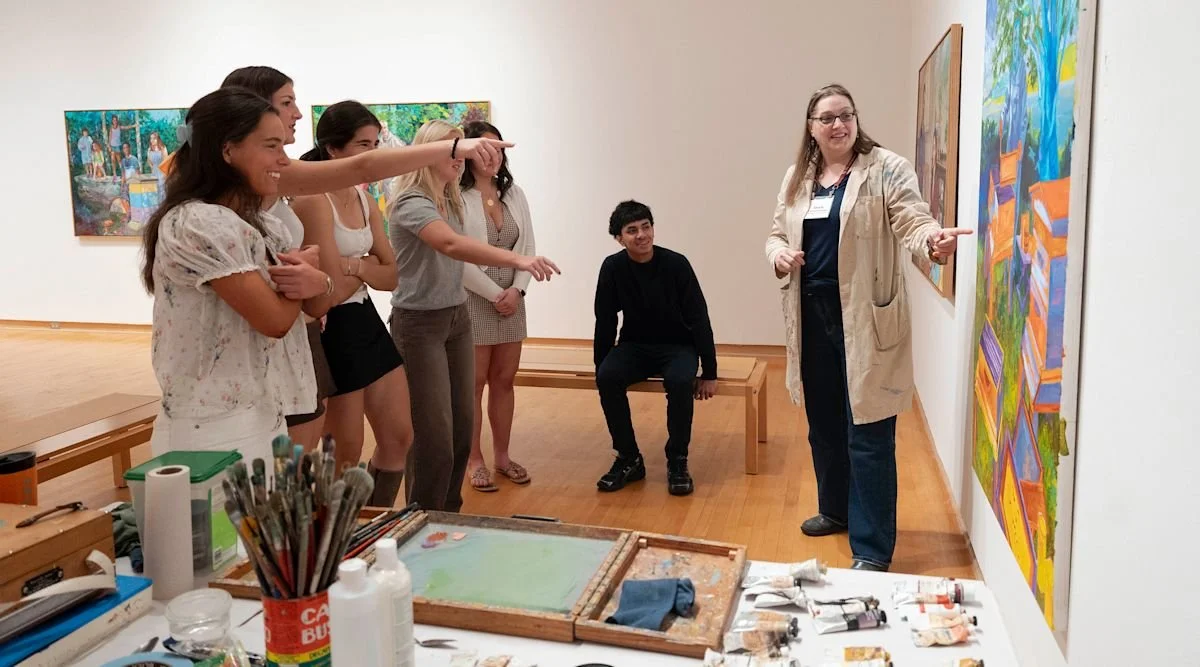
Our community exploration of the 2026-27 school year guiding question, “What does creativity look like in the 21st century?” took a new and dynamic turn this week when Rockwell Visiting Artist Charis J. Carmichael Braun brought creative vision, artistic passion, and the act of creation to the Mark W. Potter Gallery.
“Creativity in the 21st century is built on curiosity and connections,” says Carmichael Braun. “And while our attention spans are so divided and fought over, sustained creativity is something that is cultivated; it is built. And it is built by asking questions. It’s built by finding connections through different disciplines.”
Taft students joined Carmichael Braun in Potter Gallery to connect through her art—to ask questions, to consider the interdisciplinary nature of art, to learn from her process, and to create—as she continued working on pieces in her Potter Gallery show, Beekeeper Portraits. The collection, itself, is a portrait of connection. It features real people—beekeepers—living and working in Long Island, NY.
“Every participant in the project is a member of the Long Island Beekeepers Club, with their own story to share,” notes Carmichael Braun. “Like a beehive—as its own tiny world—these paintings show a particular microcosm of Long Island. These portraits illustrate diverse relationships between people and pollinators, sharing personal stories, trials, and triumphs through beekeeping.”
And that, Carmichael notes, is the essence of creativity.
“You’re not just running on instinct, but you’re finding what binds things together and then discovering them in a new light.”
Beekeeper Portraits runs through December 16th. Potter Gallery is open Monday through Friday, 8 am to 5 pm when school is in session.
Charis Carmichael Braun interviewed by Bob Falcetti at the Taft School
Charis J. Carmichael Braun earned her BA from Bethany Lutheran College, Mankato MN, and her MFA from the New York Academy of Art, New York NY. Her figurative paintings show humans engaging with fractured environments expressively depicted using poetic color. Her work has been shown mainly in the United States and has received awards and honorable mentions, most notably in 2020 she received a NYSCA grant from the Huntington Arts Council to paint portraits of beekeepers on Long Island. In 2025, she was awarded an artist residency at Weir Farm National Historical Park. She teaches Art History at Farmingdale State College SUNY and Bethany Lutheran College. She has been published in PoetsArtists, The Huffington Post, LINEA: The Artist's Voice, and Artists on Art.
_______________________________
The Rockwell Visiting Artist program allows select artists to extend their reach beyond the gallery walls, offering a residency, of sorts, that creates broader opportunities for teaching, learning, and mentoring.
Rockwell Visiting Artists spend time working directly with art students in the gallery, in our classrooms, and often connecting with the full school community through our Morning Meeting program. They interact with students and faculty across campus through a range of events and programs, which may include workshops, receptions, and small group instruction. Recent Rockwell Visiting Artists have included painters, photographers, potters, sculptors, and printmakers. The program is supported by the Rockwell Visiting Artist Fund, established in 1997 by Sherburne B. Rockwell Jr., Class of 1941, and H. P. Davis Rockwell, Class of 1944.